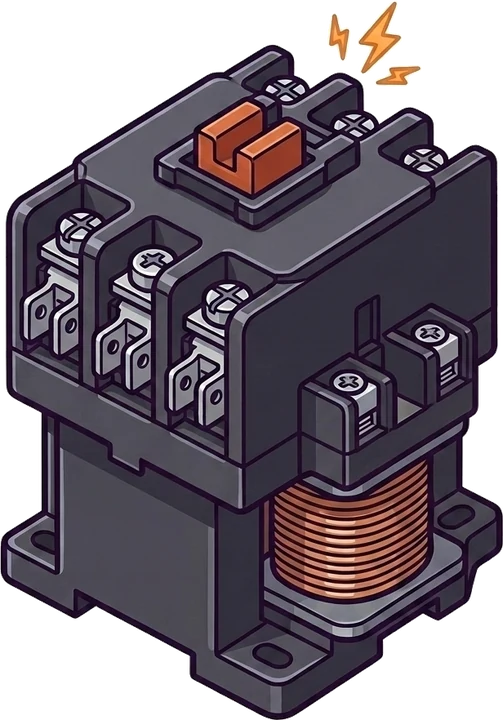
A contactor is a relay: a switch big enough to handle the serious current your outdoor unit uses, flipped by the small low-voltage signal your thermostat sends. When the thermostat calls for cooling, the contactor pulls in with an audible click and connects the compressor and condenser fan to power. When the call ends, it releases and the outdoor unit stops.
Why contactors matter in South Florida
A contactor physically clicks open and closed every single cooling cycle, and a Florida system might cycle dozens of times a day for ten months a year. Each connection makes a tiny spark, and over thousands of cycles the contact points pit and burn. Ants and lizards are also a genuinely Floridian failure mode: insects crawl between the contacts and get welded in place, blocking the connection.
Signs of a contactor problem
- The outdoor unit will not start even though the indoor fan runs.
- The outdoor unit will not stop, running even with the thermostat off, because the contacts have welded closed.
- A loud chattering or buzzing from the outdoor unit.
- Cooling that works intermittently for no obvious pattern.
What Kyzar checks
A contactor is a modest part that can imitate an expensive failure in either direction, so we test it directly: is the low-voltage coil receiving its signal, and are the contacts actually passing power through? That two-minute test, along with a capacitor check, sorts out most “outdoor unit is dead” calls without any guesswork. The contactor carries enough current to be genuinely dangerous, so this is not a cover-off homeowner check.