
Most refrigerant leaks do not start with a hot house. They start with a system that still works, just a little worse each week, and a homeowner who does not have a reason to call anyone yet. By the time the air coming out of the vents is genuinely warm, the leak has usually been running for a season or more.
That gap is also the opportunity, because the early signs are readable once you know what you are looking at. This is the honest version of what a leak looks like in a Boynton Beach home, what a technician actually does to find one, and how to tell whether the diagnosis you were given holds up. If you already know something is wrong, that is what our AC repair in Boynton Beach is for.
One thing worth settling up front, because everything below rests on it: refrigerant is not fuel. A healthy system never needs a top-off, so if the charge is low, it went somewhere. There is more on what refrigerant actually does in our glossary.
What Are the Earliest Signs of a Refrigerant Leak in a Boynton Beach AC?
The earliest signs are about effort, not temperature.
A system losing charge does not stop cooling. It works harder to reach the same setpoint, so the first thing that changes is run time. The unit that used to satisfy the thermostat by mid-afternoon now runs into the evening. Nobody notices, because in August a long run time is also completely normal, which is exactly why this stage gets missed.
The second change is humidity. Your air conditioner pulls moisture out of the air as a side effect of cooling, and a system down on charge loses that ability before it loses much cooling capacity. The house reads the right number on the thermostat and still feels clammy.
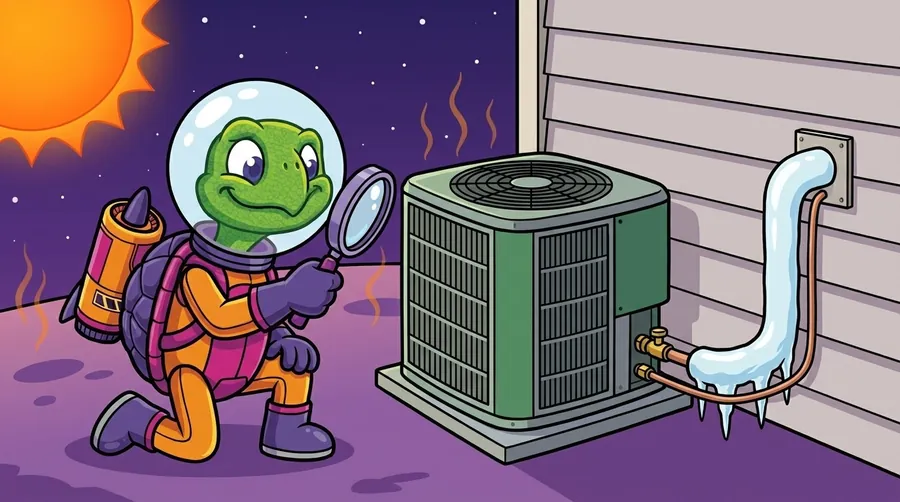
Then there is the one visual tell most homeowners can check themselves. Refrigerant circulates with compressor oil, so where refrigerant escapes slowly, oil comes with it and stays behind. One technician working a leaking condenser on camera read it before touching a tool: “you see all this discoloration? Look how dirty that is. That’s oil. And it’s going all the way up this liquid line.” Dark, damp, dust-catching residue on the copper lines, at a brazed joint, or streaking the coil is worth a photograph and a phone call.
Hissing or bubbling near the indoor unit belongs on the list too, though an audible leak is no longer an early one.
What comes after this stage, the weak airflow and the ice on the coil and the afternoon where it gives up, is a different post. Our piece on an AC that runs but will not cool picks the story up there.
How Do Boynton Beach Techs Find a Refrigerant Leak With Nitrogen or Dye?
Finding a leak is a search, and there are only a few honest ways to run it.
The first pass is visual and it is where the oil traces earn their keep. A tech follows the refrigerant circuit looking for staining at joints, at the service valves, along the line set, and across both coils. A commenter in an HVAC trade forum summarized the field version of this well: “oil puddle or residue near the condenser, oil in the drain pan, oily streaks on the coil.”
When the visual pass narrows it down, two methods confirm it.
A nitrogen pressure test is the closest thing to proof. The refrigerant is recovered, the system is pressurized with dry nitrogen, and the pressure is watched. Nitrogen is inert, dry and cheap, and it holds pressure far higher than the operating charge, so a joint that seeps under running conditions announces itself. A gauge that holds steady means the section under test is sound. One that falls means a leak in it, and soapy solution brushed over the suspect joints foams at the exact spot.
UV dye solves the other problem, a leak too slow to catch in one visit. Dye goes into the system, the system runs normally for a while, and the tech returns with a UV lamp. Wherever refrigerant has been escaping, the dye escaped with it, and it glows. Dye is the tool for intermittent and seasonal leaks because it keeps working while nobody is watching.
Neither is exotic, and neither needs special access to your walls. That matters for the next section.
Why Does an Electronic Leak Detector Struggle in Boynton Beach Humidity?
The electronic sniffer is the fastest tool in the bag and the most likely to lie to you.
Most field detectors use a heated diode sensor, and the trade’s own training resources are blunt about its weakness. HVAC School notes that a heated diode “can give false positives from some other substances” and that “the sensor is prone to fouling from moisture and oil.” Detector comparisons rate the heated diode’s false-positive risk as moderate, triggered by solvents, moisture or other gases, against a lower risk for infrared sensors.
Worth being fair: manufacturers do not fully agree. Fieldpiece argues heated diode detectors are not prone to false alarms, and that contamination costs sensor life rather than accuracy. The disagreement is genuine and nobody selling the tools has settled it.
What is not in dispute is the input. Our coils live in year-round humidity, coastal air carries salt, and a leaking system is by definition an oily one. Moisture and oil are exactly what every one of those sources names as hard on the sensor, and our equipment sits in both.
The conclusion is not that electronic detectors do not work. It is that a beep is a lead, not a verdict. A tech who hears the sniffer go off and then confirms the spot with bubbles, dye, or a nitrogen standing test is doing the job correctly. A tech who quotes a coil replacement off the beep alone has skipped a step, and you are entitled to ask which method confirmed it.
How Should a Boynton Beach Homeowner Judge a Refrigerant Leak Diagnosis?
This is the question the internet is actually asking, and almost nobody answers it.
The highest-ranking discussion on refrigerant leaks anywhere online is not a manufacturer guide. It is a homeowner asking whether they were told the truth: their technician said finding the leak would be “like finding a needle in a haystack” and they should replace the whole system instead. The reply that carried the thread came from one commenter who identified themselves as a former technician with twelve years in the trade, and it was unsparing: finding a leak, they wrote, never took more than an hour.
We would not go that far, and neither did everyone in that thread. Two other commenters pushed back with real cases: three days on a leak in a grocery store, and several days on a residential line set after a siding contractor put a nail through it. Commercial refrigeration and buried line sets are genuinely hard. A residential split system in a Florida side yard mostly is not.
So the useful test is not how long it took. It is whether a search happened at all.
Ask what was actually done. “The pressures are low” is a measurement, not a diagnosis. It tells you the charge is down. It does not tell you where it went, and a system can only be low because refrigerant left it. If nobody looked for oil staining, nobody pressurized anything, nobody put dye in and came back, then no search was performed, and a recommendation to replace the system rests on nothing but an inconvenience.
You are also allowed to want a second opinion, and wanting one is not an insult. We look at other companies’ quotes regularly and we say so when the first company was right.
Is a Refrigerant Leak Dangerous Inside a Boynton Beach Home?
For most households the realistic risk is to the equipment rather than the people, but that is not the same as no risk.
A slow leak from an evaporator coil disperses into a moving air stream in a house that exchanges air with the outdoors constantly. That is the ordinary case and it is not a household emergency. The exception is a large, fast release into an enclosed space with poor ventilation, because refrigerant vapor is heavier than air and can settle and displace oxygen in a closed utility room.
Direct contact is a separate matter. Refrigerant leaving a pressurized line is extremely cold and will cause frostbite on skin and serious injury to eyes, which is one reason opening a refrigerant circuit is not a homeowner job.
The part we will not improvise on is the medical part. Symptoms sometimes attributed to refrigerant exposure include dizziness, nausea, difficulty breathing and throat or sinus irritation. We are AC mechanics and not clinicians, so if anyone in the house is unwell, get fresh air moving, leave the space, and call a medical professional rather than waiting to see whether the AC was to blame.
When Does a Boynton Beach AC Coil Leak Become Unrepairable?
Kyzar’s position on whether to fix or replace a system is settled and it lives elsewhere: we diagnose first and quote a repair at any system age. This section is about something narrower and more technical, which is when the coil itself stops being a repairable part.
Three things decide it.
Where the leak sits. A leak at a brazed joint, a service valve, or an accessible run of the line set is a repair. A tech recovers the charge, brazes the joint, pressure tests it and recharges. A leak in the middle of a coil’s tube bundle is a different animal, because reaching it means cutting into a dense pack of tubing and fins that was not built to be opened.
Whether it is one leak or a pattern. This is the real dividing line. A single mechanical injury, a rub-through or an impact, is a repair. Formicary corrosion, the microscopic pitting driven by humidity and household chemistry, does not produce one hole. It produces a coil developing them everywhere at once. Patching one pinhole in a coil that is generating pinholes buys weeks, and a tech who has seen the pattern will tell you the coil is finished as a coil.
Whether a matching replacement coil still exists. Coils are matched to the outdoor unit and the refrigerant it runs. On older equipment the correct coil may no longer be manufactured, and fitting a mismatched one gives you a system that runs but never performs.
None of that is a verdict on your air conditioner. A coil can be beyond saving in a system very much worth keeping, and the two questions get answered separately.
What Should You Check Before Approving a Boynton Beach Leak Repair?
Five things, none of which require knowing anything about HVAC.
Ask where the leak is. Not “in the coil” but where. A tech who found it can tell you, usually with a photo.
Ask which method confirmed it. Bubbles, dye under UV, or a nitrogen pressure test. If the answer is only that the pressures read low, the search has not happened yet.
Ask whether the repair will be pressure tested before recharging. Testing the repair is not an upsell, it is the difference between a fix and a hope.
Check that whoever opens the system is certified. This one is federal law, not a preference. Under Section 608 of the Clean Air Act, the EPA requires that technicians who service equipment that could release refrigerant be certified, and that certification specifically covers adding refrigerant to or removing refrigerant from an appliance. Anyone offering to “just add a can” without it is not doing you a favor.
Ask what happens if the leak is not where they think. A good answer exists, and it is not silence.
If your unit lives near the water, the corrosion behind a lot of coastal coil leaks is worth reading on its own, and we covered it in protecting an AC unit from salt air. Regular AC maintenance is also where slow leaks get caught, because the measurements that reveal one are taken on every visit.
Quick Recap
A refrigerant leak shows up first as a system working harder: longer run times, a house that holds temperature but feels damp, and oily residue on the copper. Warm air is a late symptom, not an early one.
Finding the leak is a real search, run with oil traces, a nitrogen pressure test, or UV dye. An electronic sniffer is a fast lead and a poor verdict, especially on damp, salty, oil-filmed equipment.
You can judge the diagnosis without being a technician. Ask where the leak is and which method proved it. “The pressures are low” is a measurement, and a recommendation to replace a system with no search behind it deserves a second opinion.
If your system is not holding its charge, we would rather find out why than sell you around it. That is the whole of why homeowners keep calling us back. Schedule a visit and we will tell you what we find.