
You notice it in the first few seconds after the system kicks on. A damp, closed-up, basement kind of smell that rolls out of the vents and then fades into the background once the air has been moving a while.
It is one of the most common things we get called about here, and the honest short answer is that something inside your system is wet and staying wet. In West Palm Beach that is not a surprise. The harder and more useful question is which wet thing, because the answer changes what actually fixes it, and because a certain number of homeowners in this climate clean the obvious culprit and find the smell back within weeks. That last group is who the second half of this article is really for. It is a job for our indoor air quality techs rather than a cooling fault.
Why Does Your AC Smell Musty in a West Palm Beach Home?
Because your air conditioner is, by design, the wettest place in your house.
Cooling works by condensing moisture out of the air onto a cold coil. That coil is dark, it is wet for most of the day, and air passes over it constantly carrying dust and organic material. Every ingredient microbial growth needs is present, continuously, from roughly April to November. The smell you are noticing is the byproduct of that growth, and it is strongest at startup because the fan pushes the accumulated air across it before the system has been running long enough to move it along.
There are four places the damp usually is: the evaporator coil itself, the drain pan beneath it, the condensate drain line, and occasionally the ductwork downstream. Which one it is determines whether this is a maintenance visit or something more involved.
What Is Dirty Sock Syndrome, and Does Your West Palm Beach AC Have It?
It is a real, named phenomenon and it is worth knowing because it behaves differently from ordinary mustiness.
Dirty sock syndrome describes a specific sour, gym-bag odor that appears on startup, usually strongest in the first minutes, and often shows up seasonally. The mechanism is biological film building on the evaporator coil, which releases its smell most sharply when the coil surface changes temperature and the fan starts moving air across it.
The practical distinction: ordinary musty smell tends to be steady whenever the system runs, while dirty sock syndrome is dramatic on startup and then recedes. If yours is a sharp hit at the beginning of a cycle that fades within a few minutes, you are probably dealing with the coil rather than the drain or the ducts. One HVAC company’s video on this put the underlying situation well: a system in a humid climate is effectively going through a wet-and-dry cycle every day, which is exactly the condition that grows the film.
Which Signs Confirm Mold Is Behind the Musty Smell in Your West Palm Beach AC?
You are looking for evidence, not just odor, because several things smell similar.
Visible growth on the evaporator coil is the clearest confirmation, though on most systems you cannot see the coil without opening a panel, which is a reasonable place to stop and call. What you can check yourself: standing water or slime in the drain pan, dark staining around the pan or the base of the air handler, visible dark spotting at the supply registers, and whether the smell is stronger at the unit itself than at the vents furthest from it.
Two supporting signals matter. If household members have symptoms that ease when they leave the house, that is worth taking seriously. And if the smell got noticeably worse after a period when the system was off, such as returning from a trip, that fits growth thriving in a warm, still, humid house.
The EPA’s guide to mold, moisture and your home is the sensible reference for what mold needs and how to think about it, and its consistent theme is that moisture control, not cleaning, is what stops recurrence.
Which Damp Spots Inside a West Palm Beach AC Cause the Musty Smell?
Four places, and it is worth checking them in this order.
The evaporator coil. The default suspect and the most common answer. Wet all day, dark, and directly in the airstream.
The drain pan. It should be carrying water away, not holding it. Standing water in the pan means the drain is not doing its job, and a pan of stagnant water sitting under the coil in West Palm Beach heat will smell within days. A pan that has rusted through is its own problem.
The condensate drain line. Algae and biofilm build in the line continuously in our humidity. A partially blocked line backs water up into the pan, which produces both the smell and, eventually, an overflow. We cover that failure in detail in our guide to a clogged AC drain line.
The ductwork. Less common as an origin, more common as a place the smell gets distributed from. If ducts are genuinely wet, the cause is usually condensation or a leak rather than the ducts themselves.
Does a Musty Smell Always Mean Mold in a West Palm Beach AC?
No, and it is worth ruling out the alternatives before anyone opens anything.
A dead animal in a duct or near the air handler produces a much stronger, sweeter, more offensive smell that gets worse rather than better. A burning or hot-electrical smell is a different problem entirely and warrants shutting the system down. A sharp chemical odor can point at refrigerant and needs a tech rather than a cleaning. And a sewer-like smell is more likely a dry plumbing trap somewhere near a return than anything in your AC.
Genuine mustiness, damp and earthy and worst at startup, is the one that points at microbial growth on a wet surface. If what you are smelling does not match that description, the rest of this article may be the wrong track.
One thing to avoid while you work it out: do not reach for an ozone generator. The Florida Department of Health’s guidance on mold is clear that the fix is finding and removing the moisture source, and ozone devices are a poor substitute that carry their own risks. A homeowner posting about exactly this problem had been sold on one and warned others off it.
Why Does West Palm Beach Humidity Feed Mold Inside AC Systems?
Because growth is governed by available moisture, and we supply it almost year round.
Building-science researchers at the University of Central Florida’s Florida Solar Energy Center frame this in terms of water activity, the amount of moisture actually available at a surface, and put the threshold for mold to establish itself at roughly 70 percent. A coil in a Palm Beach County summer sits at or above that for most of the day, every day, for months. Inland houses in drier climates get long stretches where surfaces fall below the threshold and growth stalls. Ours largely do not.
Local guidance says the same thing in plainer terms. Palm Beach County’s own cooperative extension advice on avoiding mildew treats controlling indoor moisture as the whole game, and Palm Beach Atlantic University’s mold guidance for buildings in this city takes the same line.
This is why “just clean it” is an incomplete answer here. Cleaning removes what grew. It does not change the conditions that grew it.
What If Cleaning the Coil Does Not Stop the Musty Smell in West Palm Beach?
This is the situation the standard advice handles worst, and it is common enough here to deserve its own section.
The conventional answer, and the one you will find on most pages that rank for this problem, is that the coil was not cleaned thoroughly enough. Sometimes that is true. But there is a group of homeowners for whom it plainly is not. One Florida homeowner described a three-year run of this: a technician inspected a coil that was visibly clean, cleaning changed nothing, and the smell kept returning anyway. Another described being discouraged by a coil only six months old and already smelling.
The mechanism worth understanding is runtime. FSEC’s research notes that when a system short cycles, moisture removal does not reach full capacity for roughly the first three minutes of a cycle. A system that satisfies the thermostat quickly and shuts off spends a large share of its running life inside that window, wetting the coil without ever completing the drying part of the job. The coil ends up damp more of the time, not less, and recolonizes after every cleaning.
Fan setting compounds it. FSEC’s own testing shows the fan left in the ON position producing higher indoor humidity than AUTO at every setpoint, because a fan running continuously re-evaporates moisture sitting on the coil and pushes it back into the house. If your fan is set to ON and your AC smells musty, switch it to AUTO before you spend money on anything else.
The homeowner above eventually found the same thing empirically: what kept the smell away was the system getting real cooling runtime, not another cleaning.
So if cleaning has failed twice, stop buying cleanings. The question to put to a tech is whether the equipment is oversized for the house and what the actual cycle lengths look like. That is a different diagnosis, and it is the one that ends the loop.
Should You Worry About Health When Your West Palm Beach AC Smells Musty?
Take it seriously, without panic.
The CDC’s guidance on mold and health is measured: exposure to damp and moldy environments may cause a range of health effects, or none at all. For some people it brings a stuffy nose, sore throat, coughing or wheezing, burning eyes, or a skin rash. People with asthma or a mold allergy can react severely, and people who are immune-compromised or living with chronic lung disease can develop lung infections. The informative pattern at home is whether symptoms ease when someone is away from the house.
What the health agencies agree on is the response. You do not need to identify the species. Testing is rarely the useful next step. Find the moisture, remove it, and clean or replace what grew, in that order.
If someone in your home has asthma or a respiratory condition and the smell has been there a while, move this up your list rather than living with it through the summer.
When Should a Pro Inspect a Musty AC in West Palm Beach?
Some of this is genuinely yours to check, and some is not.
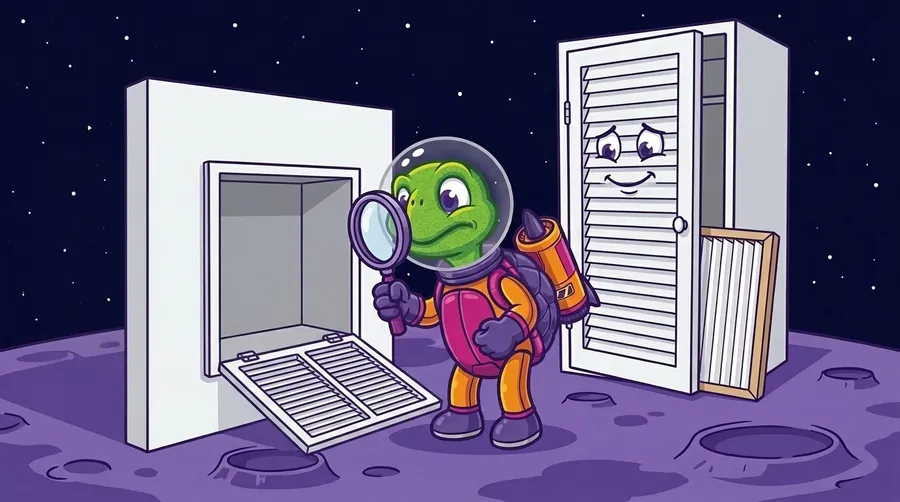
Reasonable to do yourself: replace a loaded filter, look in the drain pan for standing water, confirm water is dripping from the outdoor drain point, switch the fan from ON to AUTO, and check whether the smell is worse at the unit than at distant vents.
Worth a call: the smell returns after a cleaning, there is standing water that comes back after you clear it, you can see growth at the registers or around the air handler, the drain pan looks rusted, anyone in the house has symptoms that track with being home, or the system needs a panel opened to see the coil.
The visit worth asking for is a diagnostic one rather than a cleaning one. Anyone can sell you a coil clean. The question that matters, especially if you have already had one, is what is keeping that coil wet, and that means looking at drainage, filter and airflow condition, fan configuration, and how long your system actually runs per cycle. That is the kind of call we would rather make than book you a repeat cleaning.
The Bottom Line on a Musty AC Smell in West Palm Beach
A musty AC almost always means something inside it is staying wet, and in this climate that is the default state unless the system is drying itself properly between cycles.
Work the cheap checks first: filter, drain pan, outdoor drip point, and the fan switched to AUTO. Those resolve a meaningful share of these and cost nothing. If you find standing water or visible growth, you have your answer and it needs clearing properly.
And if you have already had the coil cleaned and the smell came back, do not buy the same cleaning again. That pattern is telling you the coil is getting wet faster than it dries, which is a runtime and sizing question rather than a hygiene one.
If that sounds like your house, book a visit and we will look at why it keeps coming back rather than just treating what we can smell. We work throughout West Palm Beach, and this is one of the most common calls of our summer.