Search why an AC keeps tripping the breaker and you get the same nine causes in a different order every time. Dirty filter, dirty coil, weak capacitor, tired compressor, bad breaker, loose wiring. All real, and all useless on their own, because that list does not tell you which one you have.
There is a faster question, and it is one our techs ask on the phone before we ever get to a Coral Springs driveway: when does it trip? A breaker that goes the instant the outdoor unit tries to start is a different problem from one that lasts forty minutes, which is different again from one that only ever trips at four in the afternoon. The timing is the diagnosis. Everything else is confirmation.
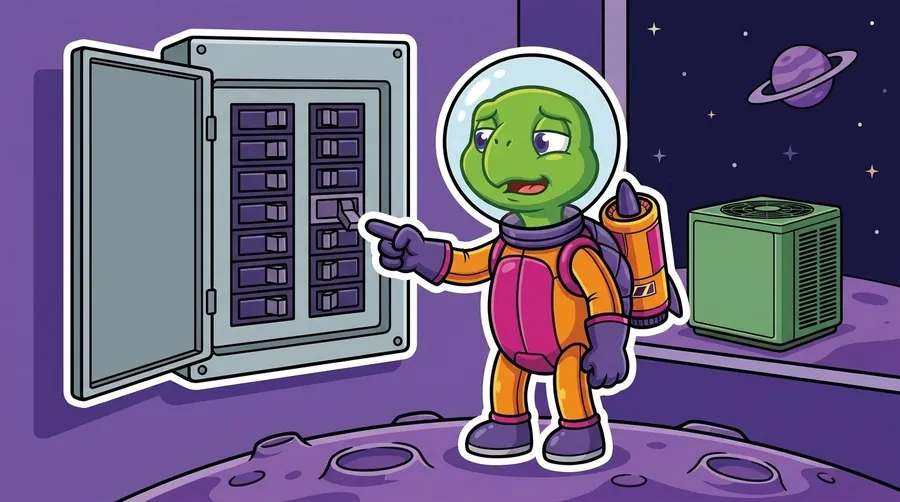
One boundary first, said once. Reset it a single time if it clearly tripped. If it trips again, leave it off and get Coral Springs AC repair moving. We have covered why repeated resets are the wrong instinct separately, along with where the panel breaker, outdoor disconnect and low-voltage fuse live. This post is about cause.
What Does It Mean When a Coral Springs AC Trips the Breaker at Startup?
An instant trip is the most informative one you can get, because almost nothing else behaves that way.
Every compressor pulls a large surge for a fraction of a second when it starts. That figure is printed on the unit’s data plate as locked rotor amps, and it typically runs four to six times the compressor’s normal running draw. Your breaker is built to absorb that surge. It is supposed to.
So when a breaker cannot survive that fraction of a second, one of two things is usually true. Either the compressor is mechanically seized, in which case it tries to pull that full locked rotor figure continuously instead of momentarily, or there is a hard short somewhere. The worst version is a grounded compressor, where an internal winding has broken loose and is touching the compressor’s metal shell. Current goes straight to ground the moment power arrives. That one is not a repair, it is a replacement, and no amount of resetting changes it.
There is a homeowner-visible tell. If your indoor lights dim noticeably as the outdoor unit kicks on, you are watching a high startup draw with your own eyes.
What separates a startup trip from everything else here is that it repeats on demand. It does not wait on the weather or the time of day. That consistency is the clue.
Why Do Some Coral Springs ACs Only Trip the Breaker on Hot Afternoons?
This is the pattern that frustrates people most: the system behaves perfectly all morning and refuses to reproduce for anyone who comes to look. It is also the pattern almost nobody explains properly. Two separate things are moving at once, and they compound.
The first is the compressor. On a hot afternoon your system has to reject heat into air that is already hot, which means it works against a much larger temperature difference. That raises head pressure, and higher head pressure means higher current draw. This is ordinary physics rather than a fault. A system with no margin left will cross the breaker’s threshold on exactly the days it is asked to do the most work, and sit comfortably below it the rest of the time.
The second gets overlooked entirely. The breaker is a physical device with its own heat response, and it does not live in a climate-controlled room. A panel mounted in a garage or on a wall that takes direct Florida sun all afternoon is a hot panel, and a breaker inside a hot panel has less headroom before its thermal element decides it has seen enough. Nothing about your AC has to change for that to tip over.
A third factor lands on the very hottest days, when the whole grid is straining. Utility voltage can sag under peak regional load, and a motor fed lower voltage draws higher current for the same work. So on the worst afternoon of the year, your compressor works hardest, your panel is hottest, and your incoming voltage may be weakest, all at once.
So the honest answer to “why only sometimes” is that the system has been marginal for a while, and the afternoon is what exposes it.
How Does a Dirty Filter Push a Coral Springs AC’s Amp Draw Past the Breaker?
Here we want to be more careful than most of what is written on this, because the popular version overstates it.
A loaded filter restricts airflow across the indoor coil. Research from Lawrence Berkeley National Laboratory on coil fouling found that in a properly charged system, a five to ten percent drop in airflow produces only a two to four percent change in efficiency, capacity and power draw. That is real but modest. A dirty filter by itself does not usually spike your current enough to pop a breaker.
What it does instead is cut capacity, which means longer run times for the same setpoint. The same paper adds the sentence that matters: for a more marginal system, already short on airflow, those effects “can be 10 to 20% or even greater.” Longer runtimes plus any other weakness is what tips a system over.
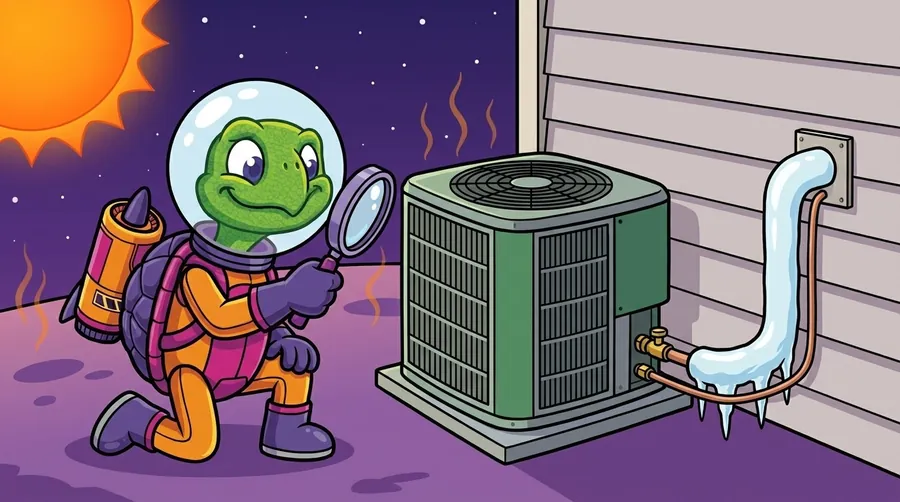
The more direct current-raising culprit is outdoors. A condenser coil matted with dirt, pollen or grass clippings cannot reject heat, head pressure climbs, and the compressor’s draw rises measurably. That is the same mechanism as the hot afternoon above, except it is self-inflicted and it happens every day rather than only in August. The same research found that typical coils foul enough to double evaporator pressure drop in roughly seven and a half years, which is well inside the working life of equipment, and a system running close to year-round in South Florida gets there sooner.
The practical read: check the filter, because it is free and matters for other reasons. But if the breaker is tripping, look hard at whether the outdoor coil needs cleaning. Keeping both ahead of trouble is most of what routine AC maintenance is for.
Can a Failing Capacitor Trip the Breaker in a Coral Springs Home?
Yes, and it is one of the more common causes we find, but the mechanism is worth understanding because it explains a specific symptom pattern.
The capacitor delivers the electrical shove that gets the compressor and condenser fan motor moving. When it weakens, the motor no longer gets a clean start. It strains, and a straining motor pulls excess current trying to get going anyway. That excess is what reaches the breaker. One technician on r/hvacadvice, one of the few posting under a verified Approved Technician flair, described the sequence plainly: the capacitor “isn’t really doing anything for the compressor, causing the compressor to overamp to compensate, causing a tripped breaker.”
Here is the part that ties this section to the last one. A capacitor that is weakening but not yet dead often behaves fine on mild mornings and fails only under peak load, because peak load is precisely when the compressor most needs the boost it is no longer getting. If your trips cluster on hot afternoons, a tired capacitor is a strong candidate alongside everything in the previous section.
Heat is what kills them, and outdoor equipment here sits in heat nearly year round, so these are parts we expect to replace over a system’s life rather than a sign anyone did anything wrong.
A caution in the other direction too. A correctly sized breaker has real margin, and a slightly weak capacitor will not always trip one. Testing tells you; guessing does not.
When Is the Breaker Itself the Problem in an Older Coral Springs Panel?
Sometimes the equipment is fine and the protection is the failure. There are two versions of this, and they are different.
The first is a worn breaker. Breakers have a finite life, and repeated trips, storm surges and years of thermal cycling weaken the internal trip mechanism until it goes at currents that are genuinely normal. The uncomfortable part is the other direction: a breaker weakened far enough can eventually fail to trip when it should, which is the outcome the device exists to prevent.
Signs that point at the breaker rather than the AC: it feels warm or hot to the touch, it trips even when the system is not running, there is discoloration or a burnt smell at the panel, or it will not hold in the on position at all. A loose connection at the terminal deserves the same suspicion, because resistance at a connection generates heat, heat degrades the connection further, and that loop feeds itself regardless of how healthy the AC is.
The second version is a mismatch, and it is specific to older panels. Florida Building Code requires that the breaker protecting a cooling system is both sized to the equipment’s own data plate and of the correct type. A Palm Beach County air conditioning changeout permit checklist states it in capitals: “ALL CIRCUIT BREAKERS PROVIDING OVERCURRENT PROTECTION FOR MECHANICAL EQUIPMENT SHALL BE H.A.C.R. TYPE PER THE UNIT IDENTIFICATION PLATE.” The same statewide code framework applies in Broward County. If a system was swapped years ago and the breaker was not, or if a previous replacement was sized by eye, the protection may never have matched the equipment it is protecting.
This is also why a good tech reaches this conclusion last rather than first. The right sequence is to check the compressor windings, check the fan motor windings, look for a short to ground, and only after all of that comes back clean does the breaker become the answer.
Does a Coral Springs AC Breaker Trip Differently From a Whole-House Overload?
It should, and the difference tells you a lot.
Your cooling system runs on its own dedicated circuit. A Florida House staff analysis of residential AC wiring describes the arrangement plainly: “There are several circuit breakers in the main electrical panel, also known as a breaker box or main panelboard. One of those circuit breakers goes to the outside air-conditioning unit and then runs to a dedicated existing electrical disconnect switch for the unit.” That dedicated breaker is the one meant to react to an AC problem.
So the normal, expected pattern is that the AC trips its own breaker and nothing else in the house notices. Annoying, but working as designed.
The pattern that deserves more urgency is the reverse: the main breaker trips, or the whole house goes dark, while the AC’s own breaker stays happily on. That ordering is backwards. If the AC circuit were simply overloaded, its own breaker should have gone first. When it does not, we shift attention to the breaker, the connection or the wiring rather than a routine overload, and it is worth checking whether the main breaker is running warm.
Worth holding onto: a breaker that trips is not malfunctioning. Assume it is sized correctly to protect the wiring, and that whatever sits on the other end is the thing to investigate.
How Long Should a Coral Springs AC Run Before the Breaker Trips Again?
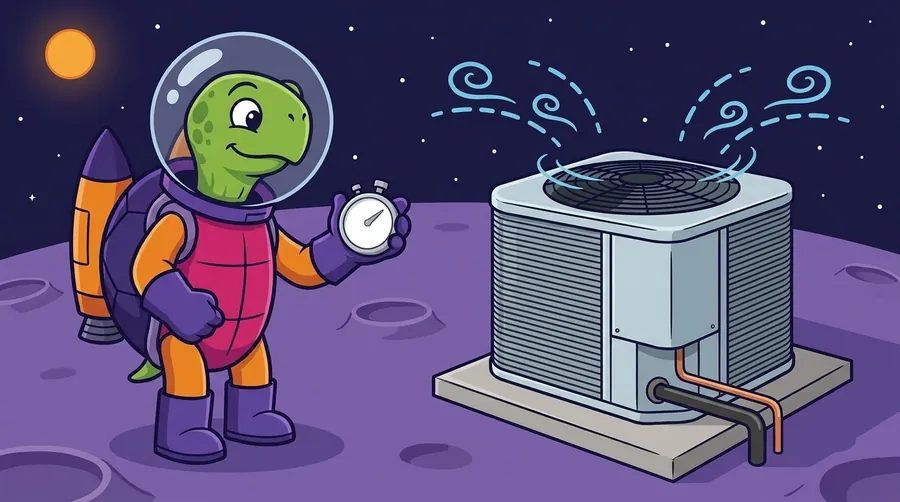
Time the gap. It is the cheapest diagnostic you have, and it is genuinely useful to whoever comes out.
Seconds, every time, points back to the startup faults in the first section. A hard short or a seized compressor does not need warm-up time.
Ten to forty-five minutes usually means something is heating up until a limit is reached. That is the profile of a system straining against restricted heat rejection, or of a condenser fan motor drawing too much and eventually letting the compressor overheat.
Several hours is the interesting one, because it often is not the AC at all. Breakers contain a thermal element that responds to accumulated heat, so a breaker can trip after a long run without current ever having climbed. If the gap is measured in hours and the system otherwise behaves, that points back at the breaker and its connections rather than at a component fault.
What matters more than any single number is whether the gap is shrinking. Forty minutes, then thirty, then fifteen is a system getting worse in real time, and it is the pattern that should move a call up your list rather than onto next week’s.
The Bottom Line
The nine-cause list everyone publishes is not wrong, it is just unsorted. Timing sorts it.
Seconds, every time: a hard electrical fault or a seized compressor. Twenty to sixty minutes: heat building where it should not, usually restricted heat rejection or a motor drawing too much. Only on hot afternoons: a system with no margin left, a hot panel, or a capacitor that fails under load. Hours apart, system otherwise fine: the breaker itself.
Note when it trips, how long the gap is, and whether that gap is closing. Then stop resetting it. We are AC mechanics rather than AC salesmen, so we would rather find which of those four patterns you have than sell you a part that fixes someone else’s problem. Schedule a visit and bring your timings with you.