Replacing an air conditioner in a South Florida summer is stressful enough without a new set of numbers to decode. Quotes for new systems now give a SEER2 rating, and it often looks lower than the SEER figure on the unit you are replacing. That is an unwelcome surprise when the house is warm and you need to decide. On its own, a lower number does not mean the new system is worse.
SEER2 is the efficiency rating that came with the Department of Energy’s newer, stricter test for central air conditioners. For an AC replacement in Palm Beach Gardens, it answers three questions: whether a system meets the federal minimum for Florida, how much electricity it needs for the cooling it delivers, and how it compares with the other quotes on your table. It does not tell you how the house will feel, or whether the installation will let the system live up to its rating. Below, we take each of those in turn.
What Actually Changed When SEER Became SEER2?
Two things changed at once, and they are easy to blur together: the test, and the minimum.
First, the test. According to AHRI, the industry group that certifies equipment efficiency ratings, residential air conditioner efficiency has been expressed as SEER2 and EER2 since January 1, 2023, measured under the federal Appendix M1 test procedure. EER2 is the companion rating, taken at a single hot-weather test point rather than across a whole season. The 2 on the end marks a number from the new test, so you can tell it apart from a number on the old one.
Second, the minimum. The floors went up at the same time, and the detail that matters for a Florida replacement is how they are enforced. AHRI’s summary of the regional standards for central air conditioners says that in the Southeast, a region that 10 CFR 430.32 defines to include Florida, the standards are enforced by the date a system is installed, and that a split-system air conditioner made before 2023 that does not meet the new standard can no longer be installed. Old stock that misses the new floor does not get a pass here.
What did not change is the direction of the number. Higher still means less electricity for the same cooling.
Why Do Palm Beach Gardens Buyers See a Lower SEER2 Number on the Same AC?
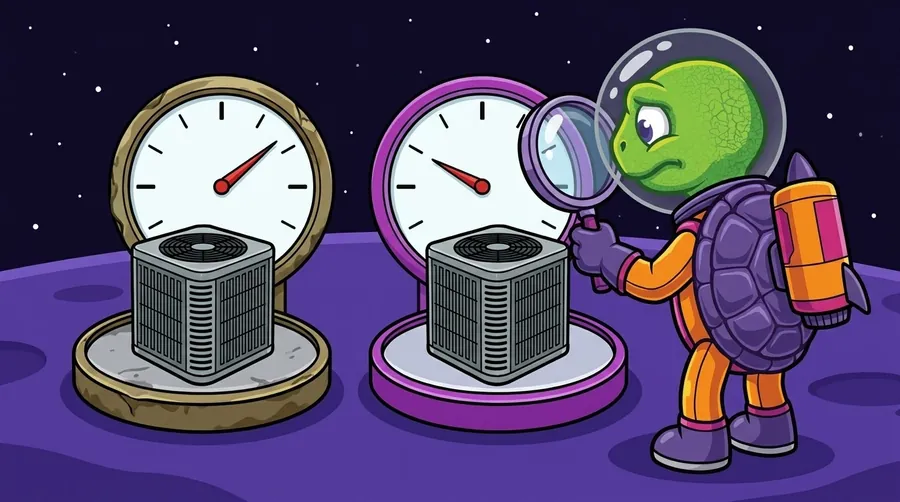
Because the new test asks more of the equipment. AHRI says the M1 test increases the external static pressure used in testing by up to five times, to reflect field conditions more accurately, and that M1 ratings come out numerically lower than ratings from the old test. Put the same equipment through both, and SEER2 is the smaller number.
AHRI’s regional standards page shows how the two scales line up: 13.4 SEER2 is equivalent to 14 SEER, 13.8 SEER2 to 14.5 SEER, 14.3 SEER2 to 15 SEER, and 15.2 SEER2 to 16 SEER.
That makes the comparison you actually face simpler. If the outdoor unit you are replacing says 16 SEER and a quote says 15.2 SEER2, AHRI’s table puts those at the same level measured two ways, not a step down. The fair comparison between quotes is SEER2 against SEER2; to set a quote beside your old unit, convert one side first. Keep in mind, too, that the label on an old unit shows the rating it was sold with, not a measurement of how it runs today.
What Minimum SEER2 Rating Applies to a New AC in Palm Beach Gardens?
Under the federal efficiency rule, 10 CFR 430.32, a split-system air conditioner installed in the Southeast on or after January 1, 2023 must be rated at least 14.3 SEER2 if its certified cooling capacity is below 45,000 Btu/h (3.75 tons), and at least 13.8 SEER2 at 45,000 Btu/h and above. Florida is on the rule’s Southeast list, so those are the floors for a Palm Beach Gardens replacement, and a packaged unit falls under the same rule’s national floor of 13.4 SEER2.
Some pages online give Florida different floors. The rule text is what a new system has to meet.
If your system went in before the new rule, the floor it was built to was lower. AHRI’s homeowner guide to SEER puts the federal minimum at 10 SEER for units made from 1992 and 13 SEER from January 23, 2006, both on the old scale. By AHRI’s dates, a system that went in about 20 years ago sits right at the changeover, and an older one was built when the floor was 10 SEER.
Above the floor, the next marker is 15.2 SEER2, the 16 SEER level in AHRI’s table. Until February 2026 it was also the ENERGY STAR line: ENERGY STAR’s Version 6.2 specification, from December 2024, asked a central air conditioner split system for at least 15.2 SEER2 and 12.0 EER2. In a December 2024 letter, the Environmental Protection Agency (EPA) sunset that specification for central air conditioners effective February 1, 2026, and told manufacturers and brand owners to stop using the ENERGY STAR name and mark on central air conditioners manufactured on or after that date. So read the numbers upward: the federal floor, then 15.2 SEER2, the former ENERGY STAR level, then everything above it, where each step saves more electricity and counts for the most in a home that runs its system hard.
If a quote or an older article counts on the federal tax credit, check the date first. The IRS describes the Energy Efficient Home Improvement Credit as covering improvements made through December 31, 2025, so it does not apply to a system installed in 2026.
How Many Hours of Runtime Does a Palm Beach Gardens AC Rack Up Each Year?
About twice as many as a system up north, by our reading of the Department of Energy’s numbers. In its guidance for residential central air conditioners, updated in December 2024, DOE’s Federal Energy Management Program (FEMP) models a 3-ton (36,000 Btu/h) system in the hot-humid Southeast states, Florida among them, as “operating 3,409 per year”, against “1,705 hours per year” for the Northern states. FEMP’s Southeast line gives no unit. We read it as hours, the reading that reproduces FEMP’s own figure of 8,074 kWh a year at 15.2 SEER2 (36,000 Btu/h for 3,409 hours). It is one assumption for a region that takes in states as far apart as Delaware and Texas, not a meter reading from a house in the Gardens, but it is the figure DOE’s purchasing guidance works from.
Those hours are where a rating turns into kilowatt-hours. FEMP’s Southeast table puts that 3-ton system at 8,074 kWh a year at 15.2 SEER2, the ENERGY STAR level as of December 2024, and at 5,222 kWh a year at 23.5 SEER2, the most efficient model on ENERGY STAR’s list at that date. By our arithmetic on FEMP’s two figures, the top system uses about 35 percent less electricity for the same cooling. FEMP notes that real savings vary with actual usage.
Here is why the hours matter. By the same arithmetic, FEMP’s Northern figures (4,038 and 2,612 kWh a year) give the same drop of about 35 percent, because both tables assume the same system at the same ratings and differ only in yearly operating time. What changes is how many kilowatt-hours that percentage is worth. On FEMP’s Northern figures, the step from 15.2 to 23.5 SEER2 saves 1,426 kWh a year. On its Southeast figures, the same step saves 2,852 kWh, twice as much, because FEMP’s Southeast model runs the system about twice as long.
Does a Higher SEER2 Rating Feel Any Different in a Palm Beach Gardens Home?
Not by itself. The rating is an energy number. Two correctly sized systems set to the same temperature should hold the same temperature, and the higher-rated one simply uses less electricity doing it. Nothing in the rating tells you how evenly the house cools or how much moisture comes out of the air, and in a humid Gardens summer, that moisture is part of how a room feels.
The rating does not change cooling power either. How much heat a system can move is its capacity, a separate figure usually given in tons or Btu/h.
What you feel comes from how the system runs and how it was fitted to the house. ENERGY STAR’s quality installation guidance says oversized equipment may cycle too frequently, resulting in less comfort, and that poor system airflow can leave the air overly damp. Neither problem shows up in the rating on a quote. If comfort is your priority, ask how the compressor stages: single-stage, two-stage or variable speed. Our guide to comparing AC brands and the specs behind them covers that choice.
Which Palm Beach Gardens Homes Gain the Least From a High SEER2 Upgrade?
Three kinds: homes that run the system fewer hours, homes that would move only a small step up the scale, and homes whose ducts or sizing will hold a new system back.
Hours first. Every kilowatt-hour figure in FEMP’s tables assumes the yearly operating time FEMP sets for its region. If your Gardens home sits closed for part of the summer, the hours fall, and so does what any rating can save. A house that runs its system hard all year gets the most from a high number.
Then the size of the step. A split system installed in Florida from 2015 through 2022 had to meet 14 SEER under 10 CFR 430.32, and AHRI equates 14 SEER with 13.4 SEER2, the lowest column in FEMP’s Southeast table. On FEMP’s figures, the 3-ton system uses 9,159 kWh a year at 13.4 SEER2 and 8,074 kWh at 15.2 SEER2, which AHRI equates with 16 SEER. By our arithmetic on those FEMP figures, that is about 12 percent less, so going from a 14 SEER system to a 16 SEER-class one is a modest step on paper. A system built when the federal floor was 10 or 13 SEER, by AHRI’s history, started lower, so the step to a new system is likely a bigger one.
Whichever case yours is, we always put a repair option on the table, even when we are recommending a replacement.
The third case, ducts and sizing, can cut into any rating gain, and it is the last question.
Can Leaky Ducts or Bad Sizing Cancel a SEER2 Gain for Palm Beach Gardens Homes?
Yes, and the loss can be large. For a split system, the SEER2 rating belongs to a specific combination of outdoor unit and indoor coil; what reaches your rooms depends on how that pair is installed in your house. ENERGY STAR says improper installation can reduce system efficiency by up to 30 percent, and no number on a quote can show that loss in advance.
Sizing and ducts are two of the ways it happens. FEMP’s guidance lists oversizing, improper charging and leaky ducts as installation problems that result in efficiency losses, occupant discomfort and shortened equipment life. A system that is too big for the house, or that pushes its air through leaky ducts, can carry a high rating and still use more electricity than that rating suggests.
Two checks help the system you choose deliver the rating on the quote. The first is proof that the pair matches: AHRI’s homeowner guide tells buyers to ask the contractor for an AHRI Certified Reference Number or an AHRI Certificate of Product Ratings, to confirm the system going into the home is properly matched to achieve its certified efficiency rating. The second is a look at the ducts and the rest of the system before the quote, not after. We diagnose the whole system, ductwork included, before quoting a replacement.
In Summary
- SEER2 numbers read lower than old SEER numbers for the same equipment because the federal test got stricter, not because the equipment got worse.
- Under 10 CFR 430.32, a new split system in Palm Beach Gardens must be rated at least 14.3 SEER2, or 13.8 SEER2 at 45,000 Btu/h and above. Above that, 15.2 SEER2 was ENERGY STAR’s split-system line until EPA sunset its central air conditioner specification effective February 1, 2026.
- By our reading of FEMP’s model, a Southeast system runs about twice the yearly hours of a northern one, so the step from 15.2 to 23.5 SEER2 saves 2,852 kWh a year on FEMP’s Southeast figures against 1,426 kWh on its Northern figures, about 35 percent either way by our arithmetic.
- The rating measures electricity, not comfort. Sizing and airflow shape how the house feels.
- Homes that run fewer hours, that would move only a small step up the scale (such as 14 SEER to a 16 SEER-class system), or whose ducts or sizing will hold a new system back gain the least.
- Installation can undo part of a rating’s efficiency, so ask for the AHRI certificate and a look at the ducts before you sign.
If you are weighing a replacement in Palm Beach Gardens, book a visit and we will diagnose the whole system, ductwork included, before quoting a replacement.