Somebody has quoted you a UV light for your air conditioner, and the quote says something like “UV germicidal light, installed.” It does not say where the lamp goes. That sounds like a detail for the installer. It is actually the entire decision.
Our position on these lamps has not changed, and it is the honest starting point rather than the sales pitch: for what they are designed for, yes, they work. A UV light at the evaporator coil keeps biological growth from taking hold on that cold, wet surface. It is not a whole-room air sterilizer, and we will not sell it to you as one. That is the answer we publish on our indoor air quality work, and it is where most articles on this topic stop.
It leaves the practical question wide open. Two different UV products are sold for a residential system, they do two different jobs, and the difference is nothing more exotic than where the lamp is mounted. Get that wrong and you have paid for a lamp that cannot reach the thing you were worried about.
What Does a Gardens Coil UV Light Do That a Duct Light Cannot?
It irradiates a surface, continuously, instead of irradiating moving air for a fraction of a second. That is the whole difference, and it is why the two products are not interchangeable.
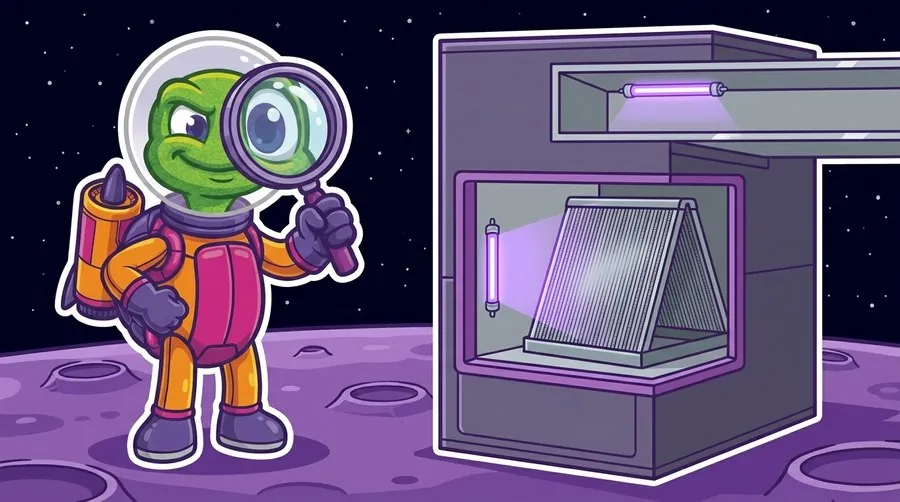
A coil light sits inside the air handler cabinet, aimed at the evaporator coil and the drain pan below it. Those surfaces do not move, so the dose builds every minute the lamp is powered. An in-duct light sits in the return or supply ductwork and treats air as it rushes past, and the air is only in front of it for an instant.
Berkeley Lab’s review of germicidal UV puts the consequence in one sentence: “Effective destruction of molds and bacteria on surfaces of cooling coils and drain pans requires a less intense UV light source than effective UVGI deactivation of particles in a flowing airstream because the surfaces are irradiated continuously while the particles in flowing air may be irradiated for a very short period.” A modest lamp handles a coil. Treating moving air is much harder: the same review reports up to 99 percent reductions on irradiated surfaces, while calling in-air results substantial but less dramatic and heavily dependent on air velocity, humidity and particle size.
Homeowners work this out and get stuck. One posted a quote for “one bulb on the air intake and one bulb on the air outflow,” told it would keep the coils clean, then asked the obvious question: how does that help my coils if they are not shining on the coils? It does not. A trade instructor makes the same point to installers, that a lamp mounted just past the air handler will not put a single bit of light on the coil because there is too much in between. His framing is the one to keep: a UV light is not like a filter, where everything downstream comes out treated. Light only does something to what it can see.
That is why mounting is fussy rather than arbitrary. A long trade-forum thread on whether to seat the lamp above or below the coil turned entirely on direct line of sight to the wet surface where growth starts. Distance from plastic matters too. UV-C degrades it, and the plastic in question is usually the primary drain pan directly under the lamp. Three separate commenters in those threads, plus the instructor above, describe the same failures: drain pans gone brittle, older media filters melted outright.
What Will a UV Light Not Clean in a Palm Beach Gardens AC?
Everything it cannot shine on, which is most of your system.
Your return ducts, supply runs, the far side of the blower wheel and every room in the house are outside its reach. A coil lamp treats the coil and the pan. It does not sanitize ductwork downstream, and if duct interiors are your actual concern, that is a separate question about what duct cleaning reaches.
It also does very little about odors and gases. EPA’s guide to air cleaners in the home notes that research has not yet shown UV light to remove gases effectively in portable residential air cleaners. That finding is about portable units rather than a coil lamp, so we will not stretch it, but nothing in the research invites you to expect a lamp to fix a smell.
Dust and pollen are not its job either. Particles are captured mechanically, by the filter, which is a separate decision: start with choosing between a MERV 11 and a MERV 13.
The biggest gap is moisture. A lamp suppresses growth on a surface; it does not remove the conditions that feed it. A homeowner in South Florida described exactly this, with mold returning to a coil after a professional cleaning because the air handler sits in a closet with no ventilation. Two people in that thread landed in the same place: an unventilated closet is a humidity trap, a neglected condensate drain leaves standing water sitting there, and growth comes back regardless of what is glowing above it. That matches what we find on service calls. A lamp above a system with a moisture problem is a lamp with a job it cannot finish.
How Long Does a UV Lamp Last in Palm Beach Gardens Humidity?
Less time than it stays lit, and that gap is the part nobody explains at the point of sale.
A UV-C lamp has two different lifespans: how long it keeps glowing, which is a long time, and how long it keeps emitting enough germicidal output to matter, which is considerably shorter. Output decays gradually across its service hours. Because effectiveness depends on the intensity of the light and how long the surface is exposed to it, a lamp at the tail of its output curve is still doing something, just steadily less of it, with no visible signal that anything changed.
Runtime is what makes this a local question rather than a national one. A lamp wired to run with the air handler in a climate with a real off-season accumulates hours slowly. In the Palm Beach Gardens homes we look after, that system runs hard from spring through late autumn and rarely stops for long, so a lamp reaches the same service hours a good deal sooner than a manufacturer’s calendar figure assumes. Humidity compounds it, because moisture on the coil is one of the variables setting how much dose is needed in the first place.
So treat any interval quoted online as somebody else’s default. What matters is the output rating for the lamp in your cabinet, against the hours your system actually ran.
How Can You Tell a Palm Beach Gardens UV Lamp Has Stopped Working?
Start from the uncomfortable fact: a spent lamp and a working lamp look identical through the sight glass.
The blue-violet glow you can see is the visible fraction of the output, not the germicidal part. A lamp can look exactly as it did on install day and be well past useful. A lit sight glass tells you the lamp has power, not that it is working.
Two failure modes are worth separating, because they call for different responses. A lamp that worked and has decayed or died is a replacement. A lamp that never worked is a product problem: the residential market carries plenty of inexpensive fixtures sold as UV-C that never produced meaningful intensity. Intensity and exposure time separate a real germicidal lamp from a purple night light, and neither is visible from outside the cabinet.
What you can check yourself is short. Is the sight glass lit, and is the power supply energized? Is there a documented install date and lamp model on the cabinet? Beyond that, the honest test is the coil itself. One building maintenance worker described a high rise where the only two of 28 air handlers that stay clean without much attention are the two with UV after the coils. That is one person’s observation, not a study, but it points at the right evidence: if your coil is fouling the way it did before the lamp went in, the lamp is not doing its job, whatever the sight glass says. A technician can measure output directly, and will look at the coil for the same reason.
Do not open the cabinet to inspect a lit lamp yourself. The next section is why.
When Do UV Lights Become a Risk in a Palm Beach Gardens Home?
When the light can reach a person or an animal, which is a question about the installation rather than about the technology.
UV-C is not a gentler version of sunlight. It works by damaging the genetic material inside living cells, which is precisely why it kills mold on a coil and precisely why it should never fall on anyone. Berkeley Lab lists human skin and eyes alongside plastics as things UV light damages. The exposures that hurt people are not dramatic: one person who works around commercial equipment described two minutes inside a running unit, with lamps firing behind reflectors so nothing hit them directly, and their face feeling burnt and their eyes swelling within four hours. Reflected UV-C counts.
So the risk lives in a few install conditions, all visible from outside. A lamp you can see while the access panel is closed. A shield that does not cover the length of the tube. A fixture mounted where light spills out at roughly the height of a dog or a cat, which is what one homeowner came home to after a new install. A correct installation puts the lamp fully inside a closed cabinet, with a shield where one is specified and an interlock that kills power when the panel comes off.
One more question before anything is ordered. EPA notes that some air cleaners, including UV lights without adequate lamp coatings, have the potential to emit ozone. Coated, non-ozone lamps are the norm now and are what we install, but confirm it in writing rather than assuming. If odor is what sent you looking at UV, our piece on musty smells is the better starting point.
If you can see your lamp lit with the cabinet shut, or the shield does not cover the tube, turn the system off at the disconnect and call somebody. That is not a wait-and-see item, and it is worth a look from whoever handles the UV and filtration options we install.
Does a UV Light Let a Gardens Home Skip Coil Cleaning?
No. It changes how often you need one and how bad things get in between, which is genuinely useful, but it does not delete the visit.
The prevention half is real. Berkeley Lab’s review credits coil irradiation with dramatically reducing growth on those wet surfaces, and with breaking down microbial films that had already accumulated where the light reaches. That is the mechanism people are buying, and it works.
The limits are geometric and physical. A coil is a dense three-dimensional array of fins, so a lamp aimed at its face lights the face and leaves shadow behind it. And a coil does not only foul biologically: it loads with dust, lint and pet hair drawn through the return, and UV does nothing to a mat of dry debris. That is mechanical fouling and it comes off mechanically. Our post on when an evaporator coil actually needs cleaning shows the difference between a coil with a growth problem and one with a dirt problem.
The drain side keeps its own schedule too. A lamp aimed into the pan helps with what grows in it and does nothing about what washes into the line.
Berkeley Lab notes one bonus worth stating carefully: by keeping coils cleaner, UV systems may improve the energy performance of the system. We will leave that as hedged as the source does. A cleaner coil transfers heat better, which is not the same as a number we can promise you.
In Summary
The mounting position is the product. A coil lamp treats a surface continuously and does the job most quotes are actually describing. An in-duct lamp treats moving air for a fraction of a second and is a harder proposition. If your quote does not say which one it is, ask that first.
Past that, expect less than the marketing suggests. A lamp will not clean your ducts, fix a smell, capture dust or solve a moisture problem. Its output fades invisibly, so it gets replaced on runtime rather than on looks. It must be fully enclosed where nobody and no pet can catch the light. And it earns its place alongside coil cleaning rather than instead of it.
If you want somebody to look at your actual air handler and say which lamp, if any, belongs in it, schedule a visit or call us at (561) 640-1000. We are AC mechanics rather than AC salesmen, and if the honest answer is that your closet needs ventilation more than it needs a light, that is what you will hear.