Ice on an air conditioner in a Boca Raton summer looks like it should be impossible. It has a plain explanation. The indoor coil got colder than freezing, and something pushed it there, usually too little warm air moving across it or too little refrigerant inside it. Bryant’s guide to a freezing AC names those two, restricted airflow and low refrigerant, as the most common causes.
If yours keeps freezing, whatever caused the first freeze is still there. A thaw clears the ice, not the problem. The first move is the same either way: switch the thermostat from Cool to Off. Then read the ice, thaw the coil without hurting anything, and know when it is time for AC repair instead of another restart.
What Does Ice on the AC Line Set Actually Tell You in Boca Raton?
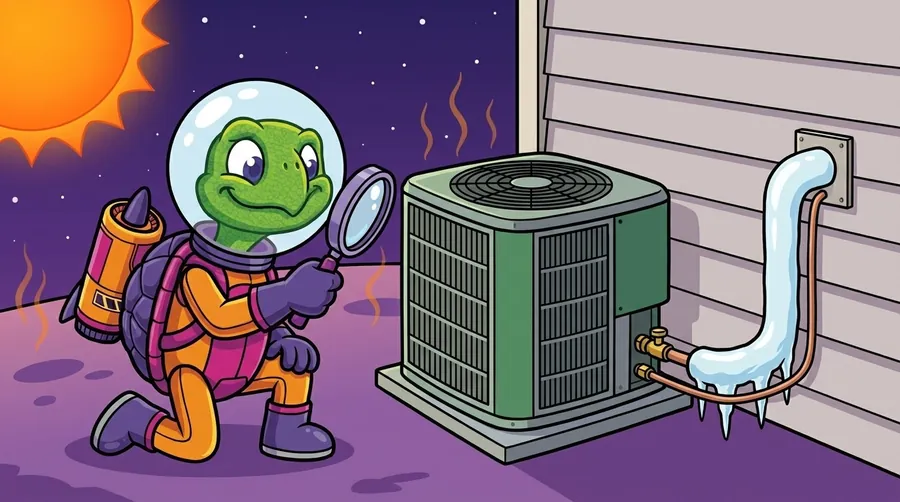
Usually, that the trouble started at the indoor coil. Ice can show up on the coil, along the copper refrigerant lines or on the outdoor unit. Trane’s guide to frozen coils says the same culprits may be behind ice on the refrigerant lines or at the outdoor unit, and that an AC’s outdoor condenser coil is unlikely to freeze in the summer. So ice on the copper lines outside is most likely reporting on the coil inside.
Lennox’s list of freezing signs adds weak or warm air from the vents, and water pooling around the unit as it thaws.
What about the weather? Lennox says running an AC when it is below 60°F outside can make it freeze up. That fits a cool night. If your coil froze in hot weather, look for a restriction instead.
Is the AC broken? Not necessarily. Bryant calls freezing a sign of an underlying issue, such as an airflow problem or low refrigerant, and says a frozen AC is not always an emergency but can become one during extreme heat. In a Boca Raton summer, treat it as urgent. If your AC runs without cooling and you find no ice at all, our guide to an AC that is blowing but not cold covers six common causes.
Why Does Weak Airflow Freeze the Evaporator Coil at Your Boca Raton Home?
Because warm air is what keeps the coil from freezing. The evaporator coil runs cold on purpose, and the warm house air crossing it keeps its surface above freezing while humidity from that air condenses on it and drains away. Starve the coil of air and the surface keeps dropping. Bryant puts the line at 32°F: once the coil’s surface drops below it, the coil can begin to freeze, and the ice can restrict airflow further and make the problem worse.
Bryant’s freeze troubleshooting framework starts with airflow, and its guide names these restrictions:
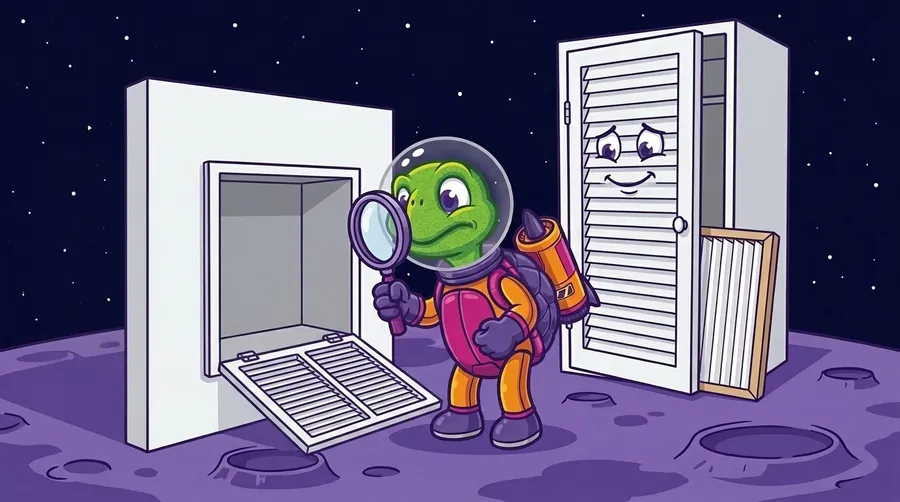
- A clogged filter, which restricts the warm air flowing over the coil.
- Closed or blocked vents. Closing vents in unused rooms can upset the system’s airflow balance, and furniture or rugs over registers can cut airflow.
- A dirty coil. Some particles can get past even a regularly changed filter and settle on the coil. Whether yours needs cleaning, and how that is done, is in our guide to the signs a coil needs cleaning.
- A weak blower. A blower motor that fails or runs at reduced speed cannot move enough warm air across the coil, and you may hear the system humming while little or no air comes out of the vents.
Lennox adds blocked ducts, grouping them with blocked or closed vents as one cause of freezing. The filter, the vents and the return grilles are yours to check. The coil, the ducts and the blower belong to a technician.
Can a Slow Refrigerant Leak Freeze a Boca Raton AC Coil?
Yes, and it surprises people, because less refrigerant sounds like it should mean less cold. It works the other way: Bryant explains that low refrigerant can lower the pressure and temperature in the evaporator, potentially pushing the coil below 32°F, where it freezes.
Low refrigerant is also a clue in itself. Fred F. Collis & Sons, a central New York HVAC contractor, says low refrigerant does not happen naturally over time and almost always means a leak. So if refrigerant was added last summer and the coil is freezing this summer, the leak was probably not found. Bryant calls a recharge without a leak repair a temporary band-aid.
From the living room, the two causes can look alike: either way the coil ices up and the cooling fades. The checks tell them apart. You can see a loaded filter, a closed vent or a blocked return; a leak is usually out of sight. Bryant’s framework checks airflow first and leaves the charge to a professional.
Confirming a low charge is not a homeowner job. The EPA’s Section 608 certification rules count attaching gauges to measure an appliance’s pressure, and adding or removing refrigerant, as the work of a technician, and require technicians who service equipment that could release refrigerant to be certified. A technician may also find a restriction instead of a leak: Collis notes that damaged or kinked refrigerant lines can affect refrigerant flow and pressure and cause the same drop in coil temperature. Hissing and bubbling are among the other leak signs, and our post on the signs your AC is leaking refrigerant covers the full list.
How Do You Thaw a Frozen Coil in Boca Raton Without Damaging the System?
Slowly, from the thermostat, without forcing anything. These steps follow Bryant’s instructions for unfreezing an air conditioner, with a power-off step added before anything hands-on:
- At the thermostat, switch the system from Cool to Off right away.
- Before any hands-on step, also turn off power to the indoor unit at its breaker, or at its disconnect switch if it has one. Leave the indoor unit’s cabinet and panels closed. If the indoor unit is in the attic, skip steps 3 and 4 rather than climbing a ladder into the heat.
- Lay towels around the base of the indoor unit, because the melting ice can make more water than the condensate drain pan can take. If water is reaching a vent or the ceiling, see our guide to water dripping from an AC vent.
- Check the filter and replace it if it is dirty. Open any closed supply vents and clear the return grilles.
- Switch the power back on, with the thermostat still on Off. If the breaker trips, leave it off and call. If your system allows it and the manufacturer’s instructions permit it, Bryant says you can set the indoor fan to On, with cooling still Off, to move air across the coil while it thaws.
- Wait for all the ice to melt. Bryant says thawing can take several hours and may take longer with heavy ice, and warns against restarting the AC while significant ice remains. Do not scrape or chip at the ice. Frost still on the copper lines means it is not done.
- Once the ice has completely melted, switch back to Cool and keep an eye on it.
- If it freezes again, turn it off and call a professional instead of restarting it again and again.
What Should Boca Raton Homeowners Never Pour, Scrape or Blow on a Frozen Coil?
When the house is hot, hours of waiting feel too long, and the shortcuts are tempting: a pot of hot water, a screwdriver, a hair dryer. Each one can turn a thaw into a repair.
Pour: Carrier’s guide to frozen coils says not to pour hot water on them, because the rapid temperature change can crack or warp the metal coils.
Scrape: Bryant says not to scrape or chip the ice, because you can damage the coil or the refrigerant tubing, and Trane warns that chipping can cause a refrigerant leak. That trades an airflow problem you could have fixed for a leak that needs a technician.
Blow: Carrier says never to use heat sources such as hair dryers to speed up thawing, because the thermal shock can crack components. Trane’s guide is the one cited here that allows a hair dryer, on a low to medium setting held six inches from the coil. Our advice is to skip it: the coil sits inside the indoor unit, so a hair dryer means opening the cabinet over dripping meltwater. The fan in step 5 already moves warm house air across the coil, and Trane and Carrier both say the fan speeds up the thaw.
Why Does the AC Ice Up Again a Day After It Thaws in Boca Raton?
Because the thaw fixed the ice, not the cause. Bryant’s answer to whether a freezing AC will fix itself is no: the ice may melt while the system is off, but the unit will freeze again once it is turned back on unless the underlying issue is resolved. A coil that ices over again a day later is the system telling you the cause survived.
The timing can narrow it down. Trane says a malfunctioning thermostat can freeze the coil, and that ice found only in the morning may mean the thermostat is not telling the AC to shut down as overnight temperatures fall. As for the setting, Collis says a very low one held for long stretches, especially overnight, can sometimes freeze the coil, and calls 68°F a rule of thumb for the lowest setting. It is a guide for the dial, not a freezing point.
If the filter, vents and returns are already sorted and the coil still ices again, you are past the homeowner checks, and Bryant’s framework calls for a dealer diagnosis instead of more restarts. Bryant says a dealer can check refrigerant conditions, test electrical components, measure airflow and static pressure, inspect the evaporator coil and the blower, and locate and repair a leak. That is the time to book AC repair in Boca Raton.
Prevention comes down to three habits: the filter changed on schedule, every vent open and every return clear, and the charge and coil checked at a tune-up. How often a South Florida filter needs changing is the subject of our separate filter guide for Coral Springs homes.
When Does a Coil That Keeps Freezing Mean Compressor Damage in Boca Raton Homes?
When it has kept running while frozen. Bryant says that operating the unit while the coil is encased in ice places extreme strain on the compressor and can lead to complete system failure.
ACHR News, the HVAC trade paper, explains the mechanism in an article on liquid floodback. When an evaporator coil freezes over, the refrigerant in it is not properly evaporated, and the liquid returns to the compressor. ACHR News says the results of that floodback can include severe damage and premature failure of the compressor.
So the risk builds with the time the system spends running iced. A system switched off soon after the ice appeared has spent far less time under that strain than one that ran frozen for days, or was restarted again and again. In a hot Boca Raton week it is tempting to leave a frozen system running for whatever cool air still comes out. That is exactly the running time the compressor pays for.
Whether the compressor was hurt is a question for testing, not for the ice. Before you accept a verdict that it is finished, ask which test showed it.
The Takeaway
- Ice on the coil, the copper lines or the outdoor unit usually means the indoor coil got too cold, most often from restricted airflow or low refrigerant.
- Check the filter, the supply vents and the return grilles first. If the coil keeps freezing, the charge, the coil and the blower are a technician’s job.
- To thaw: Cool to Off, the breaker off before anything hands-on, the fan On only if your system and its manufacturer’s instructions permit it, and no restart until the ice has completely melted.
- Skip the hot water, the scraper and the hair dryer, and let time, plus the fan where it is permitted, do the thawing.
- Ice that comes back after a thaw means the cause survived it.
- Running a frozen system is what strains the compressor.
If your coil keeps icing over, book a repair visit and let a technician find the cause before the compressor pays for it. Someone is on call seven days a week.