
Every article on this subject ends in the same sentence: if your AC smells like burning, shut it off and call someone. That is correct, and we will say it once here too. If the smell is sharp, getting stronger, or paired with smoke, sparking or a breaker that will not stay on, turn the system off at the thermostat and get a Port St. Lucie AC repair visit moving.
Now the part nobody writes down. “Burning” is not one smell. A dry dusty singe on a system that has been off three weeks is not the same event as an acrid plastic smell that worsens the longer it runs, and treating them identically means you either panic over nothing or ignore something that matters. Here is how to tell them apart.
What Kinds of Burning Smells Come From a Port St. Lucie AC?
Start by naming what you are smelling. The character narrows the cause faster than anything else.
Dry and dusty. Dust settles on the coil and motor housing while a system sits idle, then singes when warm components come back to life. It reads like a hot vacuum cleaner. This is the one that is usually nothing.
Sharp, plasticky, chemical. This is wire insulation getting hot enough to break down. It is distinctly different from dust, and it is the smell that should get your attention.
Fishy, or sharply like ammonia. Worth knowing because almost nobody mentions it. The plastics and flame retardant resins in electrical components release amine compounds as they overheat, and amines smell like rotting fish. If your air smells faintly of fish and nobody cooked any, read it as an electrical warning, not a kitchen mystery.
Hot metal. More mechanical than electrical, and often the first sign of friction somewhere that should be spinning freely. More on that below.
Oily. A brand new system can carry assembly residue that burns off on its first run. Unremarkable on new equipment, worth a question on anything else.
One note on burning rubber. Plenty of guides list a slipping belt. Most residential air handlers here are direct drive, with the motor coupled straight to the blower wheel and no belt to slip, so it is a rare answer in a Port St. Lucie house. If yours is one of the minority still belt driven, it applies. Otherwise look elsewhere first.
How Do You Tell Dust Burn-Off From Wiring in a Port St. Lucie AC?
Four tests, all of which you can run yourself.
Does it fade? This is the most reliable one. Dust burn-off is a finite layer of dust being consumed, so it weakens the longer the system runs. An electrical smell is an active heat source, so it holds steady or gets stronger. A smell that intensifies over the course of a cycle is not dust.
Does it come back? Genuine burn-off does not return once it has burned off. If the same smell arrives on the next start, and the one after that, something is producing it fresh each time.
What does it smell like? Dry and dusty points one way. Sharp, chemical or plasticky points the other. Trust the distinction. It is real.
What else changed? Dust burn-off arrives alone. An electrical problem tends to bring company: a new noise, weaker airflow, a system cycling oddly. A smell with no other symptom is more often benign than one that shows up alongside something else.
What Makes a Port St. Lucie Blower Motor Run Hot Enough to Smell?
The blower motor is the usual suspect for a hot smell that is not obviously electrical. The familiar explanation is restricted airflow, a loaded filter or a dirty coil forcing the motor to work harder. That is true and it is covered elsewhere. Two other causes get almost no coverage, and both make the same motor run hot with the airflow perfectly fine.
Bearing drag. The motor’s bearings have to spin freely, and they rely on lubrication to do it. As they dry out or wear, friction rises and generates heat directly at the bearing. That is a mechanical heat source rather than an electrical one, which is why it smells like hot metal rather than melting plastic. Our cooling season runs close to ten months, so a motor here logs far more hours a year than the same motor would up north, and bearings get there sooner. ENERGY STAR’s own maintenance checklist puts it plainly among its annual items: “Lubricate all moving parts. Parts that lack lubrication cause friction in motors and increases the amount of electricity you use.” Bearing drag usually builds slowly and brings a grinding or squealing noise along with it.
A weakening capacitor. The capacitor gives the motor the electrical push it needs to reach and hold its proper speed. Without that push the motor never quite reaches its rated speed, and a motor running slow under full load sheds the difference as heat. Matt Akins, who runs HVACR education at the Air Conditioning Contractors of America, describes a capacitor operating outside its specification as putting undue strain on the motor and forcing it to work harder. This one behaves differently from bearing drag: it tends to arrive suddenly rather than build, sometimes with an audible pop, and one homeowner described the smell memorably as a cap gun going off somewhere in the house. A motor with a failed capacitor often will not start at all rather than run weakly.
What Does a Sharp Chemical Smell Mean in a Port St. Lucie AC?
We have already published the short version of this, on our post about what a musty AC smell actually means: “A sharp chemical odor can point at refrigerant and needs a tech rather than a cleaning.” That is the right instinct. Here is the longer answer, because the word sharp is doing more work than it looks.
Refrigerant, on the rare occasions its smell is detectable at all, is consistently described as sweet, closer to chloroform or nail polish remover than to anything acrid. Many leaks have no detectable odor whatsoever. So a genuinely sharp, acrid smell is arguably evidence against a simple refrigerant leak rather than for one.
What does produce a sharp chemical smell is a compressor failing from the inside. When a compressor’s motor windings burn out, the heat and arcing inside the sealed system contaminate the refrigerant and oil, and moisture reacting with that oil forms acid. HVAC trade training material describes the result as acidic and genuinely pungent. That is a more serious event than a leak, and a real candidate whenever the smell is sharp rather than sweet.
There is a third possibility worth knowing about here specifically, because Florida still has a large stock of older systems running R-22. The EPA warns homeowners that a product marketed as “R-22a” is falsely sold as an R-22 replacement while actually being a hydrocarbon blend built on propane and butane. In the agency’s words it “may also contain small amounts of other hydrocarbons or a pine-scented odorant,” and in a system not designed for a flammable refrigerant “it can burn or explode.” A piney chemical smell is not on anyone’s normal list, and if a previous service call topped your system off cheaply, it is worth asking what went in.
A last distinction that helps. A smell present under load and gone when the system is off points at the equipment. One that drifts in and out regardless of what the AC is doing more often points somewhere else, a thread we pick up below.
How Long Should a New Port St. Lucie AC Smell Like Burning Dust?
Most advice on this is written for a climate we do not have. It assumes a dramatic seasonal restart after months off. Here the AC runs nearly year round, so there is rarely one big first-run moment.
Two situations do produce genuine burn-off locally: a brand new system on its first ever run, burning off assembly residue and packing dust, and a system that has sat idle an unusual stretch, such as a closed-up seasonal house or one down for a repair.
In both cases, expect it to fade within an hour or a few hours of actual runtime. Not days. It should be weakest at the end of a long cycle and gone by the next start. If it survives several hours of cumulative running, or returns every cycle, it has stopped being burn-off and become a question. Which brings us to the sort.
Which Burning Smells Mean a Port St. Lucie AC Should Stay Off?
Here is the triage, in three tiers.
Stop it now and leave it off. Any sharp plastic or hot electrical smell that holds steady or strengthens as the system runs. Any fishy or ammonia smell. Any smell arriving with visible smoke, sparking, buzzing or crackling, or lights that flicker or dim. NFPA’s own electrical safety guidance names a burning or rubbery smell from an appliance, sparks from an outlet, and flickering or dimming lights on the same short list of reasons to call a qualified electrician. Add to that any burning smell paired with a breaker that trips again the moment you reset it, which we have covered separately in our guide to an AC that will not turn on, and any visible scorching near the outdoor disconnect or the air handler. Looking is fine. Opening an electrical compartment is not.
Worth watching. A dry dusty smell at startup that is fading as the system runs, on a system that is new or has been idle. A faint hot metal smell with nothing else changed, no new noise and no drop in airflow. Neither is an emergency. Both graduate to the tier above if they persist past a few hours of runtime or return on the next cycle.
Consider that it might not be the AC. A technician on a service call spent an extended visit chasing a burning electrical smell that a building’s staff were certain came from the air conditioning, because it seemed to stop whenever they shut the system off. He checked motor amp draw, capacitor values, belts and refrigerant pressures, and found nothing wrong. The source was an overheating television power supply sitting right beside the return air grille. The AC was not faulty. It was pulling someone else’s problem through the building and taking the blame for being the thing that happened to be running.
That pattern is common enough that techs recognize it. So before concluding the system is failing, notice whether the smell is strongest at a supply vent or the air handler, or somewhere else entirely. That is one more data point, not a reason to wait. If anything in the first tier is present, the sort is over and the answer is to shut it off.
What Should a Port St. Lucie Homeowner Check After the Smell Stops?
A smell stopping tells you something changed. It does not tell you the cause is gone.
Genuine dust burn-off simply stays gone. If it was electrical, a bearing or a capacitor, the smell may have stopped only because the system shut itself down on a limit, or because you turned it off. None of those parts repair themselves, and the smell returns the moment the system runs again.
Four things worth doing once things are calm:
- Pull the filter and look at it. Loaded filters are cheap to rule out and they matter for other reasons anyway.
- Listen through a full cycle. Did the smell return? Is there a noise now that was not there before? A new sound alongside a recent smell is a much stronger signal than either alone.
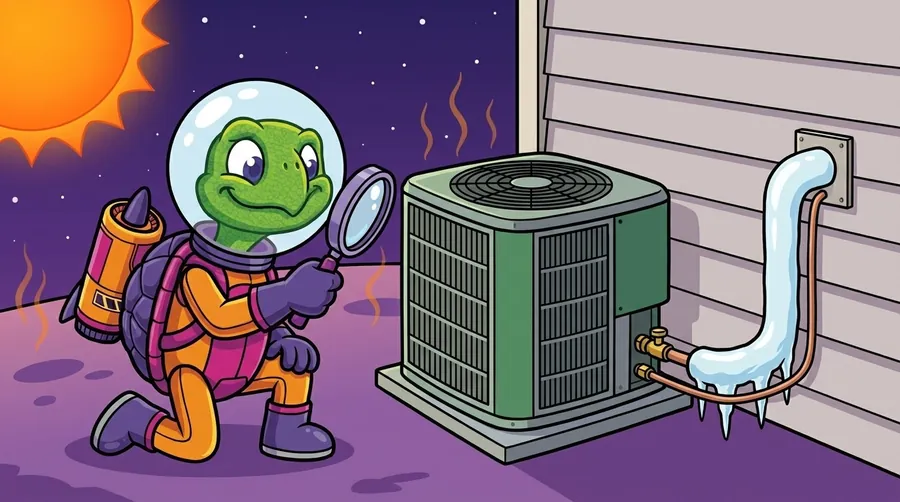
- Look, without opening anything. Nothing scorched or discolored near the outdoor disconnect or around the air handler. Panels stay closed.
- Rule out the neighbors. Per the third tier above, confirm the smell really did track the AC and not a device, fixture or appliance sharing the same return air path.
If it all comes back clean, this is a routine maintenance conversation rather than an emergency one. It is worth having. NFPA’s national fire data attributes roughly 9 percent of home electrical fires to heating, ventilating and air conditioning equipment. That is not a reason to panic about a dusty smell. It is a good reason not to let a sharp one go unexamined.
Wrapping Up
Sort before you worry. Dry and dusty on a new or long-idle system, fading as it runs and not returning, is almost always burn-off. Sharp, plasticky, fishy, or strengthening as it runs is the tier where the system stays off until someone qualified has looked. Hot metal with a new grinding noise points at the blower motor rather than the wiring. And a smell that does not track the AC running may not be the AC at all.
We are AC mechanics rather than AC salesmen, so we would rather help you tell those apart than sell a part to a house that did not need one. If you land in the top tier, leave it off and schedule a visit. We cover Port St. Lucie and the Treasure Coast.